Showing posts with label driving. Show all posts

Wednesday, March 16, 2016

2016 Tax Special *UPDATE

Simpson Brothers Garage is here to give you a tax break! We will pay up to $25 in sales tax on your repair PLUS give you a free courtesy inspection - just print the coupon or bring it up on your mobile to get this great deal! For more questions or to book an appointment, call 970-241-6682 today!
Click the link to print this great deal:
http://tinyurl.com/SBGTax2016Insp
Our courtesy inspection includes:
Inspect Brakes, Tires and Front End
Inspect Heating and Cooling System
Inspect Charging System and Battery
Inspect all Fluid Levels
Consultation
TaxBreakSpecial2016

Tuesday, August 18, 2015

Travel Tips


One of the fastest ways to put the brakes on a great vacation is with an emergency. But by planning ahead and preparing properly, travelers can minimize risk by following these precautionary tips: 


Car Maintenance:

  • Consider having your car checked by a Simpson Brothers automotive technician before a long trip. An ounce of prevention can be worth a pound of cure.
  • Check the tires regularly for uneven or excessive tread wear. Make sure all items, including the spare, are inflated properly. Do at least one check BEFORE hitting the road, as tires hot from driving give inaccurate inflation readings.
  • Check the coolant level and condition, making certain the proper 50/ 50 mixture of water and coolant is present.
  • Check the level and condition of the engine oil. If driving under extreme conditions - such as very hot summer weather or pulling a heavy trailer - you may want to consider switching to an oil with higher vis­cosity. Check your owner's manual for specific recommendations.
  • Look for worn, cracked, blistered or soft belts or hoses. Always perform this check with the engine off.
  • Hot weather can shorten the life of a car's battery - if there's concern, have it tested by a qualified auto-motive technician at Simpson Brothers Garage.


Travel Planning:

  • Carry an emergency kit with a flashlight, extra batteries, warning devices such as flares or reflective trian­gles, jumper cables, a first-aid kit and extra water.
  • Don't let the gas level get below one-quarter of a tank.
  • Select your route on a map ahead of time and study it to know exactly where you're going.
  • Reserve all accommodations in advance.
  • Lock your car when you leave it and keep valuables out of sight.
  • Secure children and adults in safety seats, booster seats or seat belts as required by law.
  • Bring books, games, or music for the ride, and a pillow so passengers can sleep.
  • Bring information on your destination to make the most of your trip.

For more helpful tips and information, visit www.SimpsonBrothersGarage.com


Source: newsroom.AAA.com, edited by Amanda Walton

Saturday, April 13, 2013

Tax Refund 2013 - Simpson Brothers Garage

As tax season comes to a close this year, we've decided to offer a 'tax refund' of our own.  

car repair coupon
Click here for printable version

Print this coupon and bring it in to our shop or show it to us on your smart phone, and we'll pay for your sales tax on your repair up to $20! So whether you received a refund or not, we're here to give you a 'break' this tax season.   

Sunday, February 17, 2013

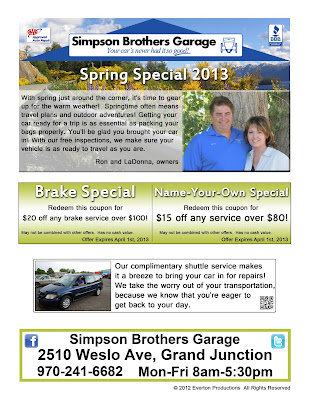
Spring Flyer 2013 - Auto Repair Specials

To our dearest customers,

Spring is closer than you think!  Which means it's time for a new Spring Newsletter :).  Read below for a quick update from the owners and get our two awesome coupons!  We're here to help you start the new season off right.

auto repair flyer coupon

Wednesday, October 3, 2012

AAA Car Care Month - Winter Car Care Checklist


In honor of October being AAA car care month - we would like to remind drivers to have their car ready for the change in seasons!  We at Simpson Brothers Garage are happy to help you prepare your vehicle for the coming months.  Here is a winter car care checklist to help you prepare, or drop by Simpson Brothers Garage, a certified AAA repair shop! 

Simpson Brothers Garage has free inspections to help you prepare for fall and winter driving!


Winter Car Care Checklist

Battery and Charging System –  During the cold winter months a fully charged battery will start much better - making your morning commuter vehicle more reliable.  At Simpson Brothers, we can test and replace your car's weak battery.
Battery Cables and Terminals – we will check to see if your battery terminals and cable ends aren't corroded and the connections are tight.
Drive Belts – we can check the accessory drive belts for cracks or fraying. Often times, newer belts are made of materials that don't show more obvious signs of wear - it is a good idea to have them replaced every 60,000 miles.
Engine Hoses – Inspect cooling system hoses for leaks, cracks or loose clamps. Also, squeeze the hoses and replace any that are brittle or excessively spongy feeling.
Tire Type and Tread – Snow tires provide the best winter traction, however all-season tires work well in light-to -moderate snow conditions provided they aren't too worn down.  To remain safest on winter roads you should replace any tire that has less than 3/32-inches of tread. Make sure your tires don't show signs of uneven wear - this can mean your alignment, wheel balance or suspension may be off, and can damage your tires or worse - it may mean a costly repair.
Tire Pressure – Make sure all four tires and the spare are inflated properly more often during the fall and winter. As the temperature drops, so will tire pressure (usually one PSI for every 10 degrees Fahrenheit). The proper tire pressure can usually be found in the owner’s manual or on a sticker typically located on the driver’s side door jamb.
Air Filter – Hold your engine's air filter up to a lit 60 watt bulb - it's a good way to see how clean it is.  If you can see light through much of the filter, it is still clean enough to work efficiently. However, if the light is mostly blocked, it's time to replace it.
Coolant Levels – When the engine is cold, check the coolant level in the overflow tank (or let one of us at Simpson Brothers check for you!). If the level is low, add a 50/50 solution of coolant and water to maintain the necessary antifreeze capability. You can test the antifreeze protection level annually with an inexpensive tester available at any auto parts store.  
Lights – It may seem like a no-brainer, but be sure to check the operation of all headlights, tail-lights, brake lights, turn signals, emergency flashers and back-up lights. Replace any burnt out bulbs - it's always safer to be seen!
Wiper Blades – The ideal blades should completely clear the glass with each swipe. Replace any blade that leaves streaks or misses spots. Consider installing winter wiper blades for snowy weather- blades which have a 'wrap' in a rubber boot, reducing ice and snow buildup that can prevent good contact between the blade and the glass.
Washer Fluid – Fill the windshield washer fluid reservoir with a solution that has 'antifreeze' qualities to prevent it from freezing (the solution will usually be labeled with 'winter', or 'antifreeze' in the description).
Brakes –  Have your brake system inspected by a certified technician if there are any signs of problems - ensuring all parts are in good working order.
Transmission, Brake and Power Steering Fluids – Check all fluids to ensure they are at or above the minimum safe levels.  We at Simpson Brothers will help you with this!
Emergency Road Kit – It is always a good idea to carry an emergency kit equipped for winter weather. The kit should include:
  • Mobile phone, pre-programmed with rescue apps and important phone numbers including family and emergency services, and car charger
  • Drinking water
  • First-aid kit
  • Non-perishable snacks for both human and pet passengers
  • Bag of abrasive material (sand, salt, cat litter) or traction mats
  • Snow shovel
  • Blankets
  • Extra warm clothing (gloves, hats, scarves)
  • Flashlight with extra batteries
  • Window washer solvent
  • Ice scraper with brush
  • Cloth or roll of paper towels
  • Jumper cables
  • Warning devices (flares or triangles)
  • Basic toolkit (screwdrivers, pliers, adjustable wrench)


This winter car care checklist is provided courtesy of AAA.

Wednesday, June 27, 2012

Wildfire Driving Safety

Colorado wildfire picture
Wildfire in northern Colorado Springs,
courtesy of Kimberly Fuller

Sadly there are many wildfires around the state of Colorado right now, and with that comes increased traffic risk: more distracted drivers, traffic from evacuations, etc.  While these fires haven't hit as hard on the Western Slope, we know travel this Summer is a part of many of our friends' and customer's plans.  If you find yourself near a wildfire area please be extra cautious on the road.

The Waldo Canyon fire,
courtesy of KKTV 11 News

1.  Pay attention to road signs, and/or local news and radio broadcasts: many roads and highways may have detours or may be closed all together.  These detours have been set up to help traffic divert from dangerous areas.

Ashes from fire,
courtesy of Cindy via KKTV.com

2.  Make sure to watch out for distracted drivers:  if you find that you are driving close to a wildfire area, you will probably see smoke and flames.  As tempting as it may be, please do not take a picture or stare at the smoke and fire for a prolonged period while driving.  If you must, find a safe place to pull off before snapping a picture.  While this may seem like common sense, many drivers will not and have not done this, and as a result many accidents on highways and roads have occurred.

A plane near Flatirons in Boulder dropping fire retardant,
courtesy of the Daily Times Call

3.  Watch out for ash, smoke, and debris in the air.  All of these pollutants can pose a danger when driving, impairing your visibility on the road.  The smoke may also affect those in your car with (or even without) asthma and breathing problems.  Stay alert and should you or one of your passengers start to have difficulty breathing pull off into a safe area to catch your breath, administer your asthma medication, or try to find a spot with cleaner air.  Even if it is a small detour from your destination, it will be worth it in the long run.

Roadway evacuation,
courtesy of Craig T. Roberts, DVM Inc.

4.  Be aware of evacuation areas.  Along with news and radio broadcasts, you can also find evacuation areas online by a simple google search.  Make sure when planning your travels that your trip will not take you through evacuation areas where the traffic will be especially heavy from people leaving their homes.

High Park fire, 
courtesy of KKTV 11 News

5.  Lastly, make sure that above all else your family and friends are safe.  If you find yourself in a situation where you are near a fire - even if you  haven't heard of a road closure or evacuation - use your instincts.  If the situation looks unsafe to you, it probably is.  Try to find a safer route to get to your destination.

Hope you have safe travels this summer, and please send a happy thought or prayer to all those affected by Colorado's wildfires.

Thursday, March 22, 2012

Was Driver's Ed Wrong?

If you have attended official driving classes, the information you learned may have been wrong.


According to MSNBC, and other sources, the advent of safer cars may mean your driving style is dangerously out of date.  Have you ever heard of the 10 o'clock & 2 o'clock positions?  That usually refers to the position of your hands on a steering wheel, if that steering wheel resembled the face of a clock. This was taught in almost all Driver's Ed classes until recently.  
Now, due to the advent and mass-production of much safer vehicles equipped with airbags, those hand positions may cost you an arm... quite literally.  
According to  AAA, in addition to severe hand and arm injuries, airbag detonations have also been known to slam arms and hands into a person's face, causing concussions, broken noses, and other related injuries.


The best position for your hands now is said to be the 9 o'clock and 3 o'clock position.  Some sources even go one 'hour' lower and say the 8 o'clock and 4 o'clock position is ideal, although in studies the 8 and 4 position may decrease the control over your vehicle. In any case, should you get into an accident, these new positions should leave enough room for your airbag to deploy properly without causing you major injury.

An example of the "9 and 3" hand position.

According to the American Driver & Traffic Safety Education Administration, a proper handhold should be firm, yet relaxed; both hands positioned on the outside of the wheel; where your fingers maintain control the wheel instead of your palms, and thumbs should be in an upward position along the steering wheel's "face"; and lastly, make sure you never utilize the inside of your steering wheel to make a turn.  Keeping these tips in mind should decrease an airbag injury significantly in the case of an accident.

Were you taught the "hand-over-hand" turning style?  That can also cause you similar injuries.

Remember, if you have an air-bag equipped steering wheel, this turning style can cause you the same problems as the "10 and 2" driving position, and cause you serious injury.  The proper way to turn is now said to be the push-pull method, pushing up with one hand and pulling down with another.  
This will keep your airbag deploying properly, and make sure your airbag doesn't do you more harm than good.

References:
AAA.com
MSNBC.com  Article by M. Alex Johnson
ADTSEA.com
Photo courtesy of Morguefile.com